Have a Question About Citizenship?
Immigration Consultant Services
I Provide the Following Immigration Forms Assistance
U.S. citizens and lawful permanent residents can petition immediate family members for green cards.
K-1 visa document preparation for U.S. citizens bringing a foreign fiancé(e) to the United States.
I assist with completing National Visa Center immigration processing forms and document packages.
Complete N-400 document preparation, organization, and filing support for U.S. citizenship applicants.
Immigration Consultant For I9 Verification Form or as an I-9 Authorized Representative For Remote Hire Employees
Click Here for More InformationCitizenship & Naturalization in California: The Complete Guide to Becoming a U.S. Citizen
I provide immigration document preparation services as a California registered and bonded immigration consultant under BPC §22440–22448.
If you're a green card holder in California thinking about citizenship right now, you're probably weighing two things at once: the fear of doing nothing and the fear of getting it wrong. Both are justified. In 2026, ICE has made 539 arrests in the San Francisco area alone during USCIS interviews, with 53% of all immigration arrests happening at USCIS offices — and 69% of those arrested had zero criminal record. At the same time, USCIS is sitting on 11.3 million pending cases, up 16.5% from last year, and the agency's denial rate has climbed to 12.2% across all case types. The system is slower, stricter, and more unpredictable than it's been in years.
That's the reality. Here's the other side: naturalization is still the single most protective step you can take. U.S. citizenship provides substantially greater security than permanent resident status — while a green card can be revoked or abandoned, naturalized citizenship can only be revoked in limited circumstances under federal law, such as fraud or concealment of material facts during the naturalization process. You can vote. You can sponsor immediate relatives without years-long waiting periods. And you stop being subject to the enforcement climate that has green card holders across California skipping medical appointments and pulling their kids out of public programs out of fear.
I'm Shafi Afridi, a California registered and bonded immigration consultant based in Costa Mesa. I've spent more than six years preparing citizenship and naturalization applications for families across Orange County, Los Angeles, Riverside, and throughout California. I speak English, Urdu, Pashto, and Hindi. I prepare your Form N-400 using information you provide, organize every supporting document, and make sure nothing is missing before your application reaches USCIS — because right now, with this backlog, a single Request for Evidence can push your case behind thousands of others. This page covers everything you need to know about naturalization in California: the general requirements, the full step-by-step process, the updated 2025 Naturalization Civics Test with 128 questions, realistic processing times for every California field office, what it actually costs, and where most applicants make the mistakes that cause delays.
What's the difference between citizenship and naturalization?
Citizenship is the legal status. Naturalization is the process of earning that status as an immigrant. You can be a citizen by birth (born in the U.S. or to U.S. citizen parents), or you can become one through naturalization — filing Form N-400, passing the interview and civics test, and taking the Oath of Allegiance. This page focuses on the naturalization path.
Who qualifies? Naturalization eligibility requirements
Before filing anything, you need to understand the general requirements. USCIS will not refund your filing fee if your application gets denied for a basic requirement you missed, and a denied case costs you far more in time than a few hours of upfront preparation. I've seen people on Reddit describe spending $50,000 on lawyers over 11 years with no result — and in nearly every story like that, the problem started with filing before the requirements were properly understood, or filing with the wrong approach entirely. If you have questions about whether you legally qualify for naturalization, consult a licensed immigration attorney or DOJ-accredited representative. My role is to prepare your documents accurately and completely once you're ready to file.
Here are the core requirements for naturalization eligibility in 2026:
- Green card for at least 5 years (or 3 years if married to and living with a U.S. citizen spouse)
- Continuous residence in the United States for the required period — absences over 6 months but under 1 year may create a rebuttable presumption of broken residence; absences of 1 year or more generally break continuous residence unless Form N-470 was filed before the 1-year mark
- Physical presence in the U.S. for at least 30 months out of the past 5 years (18 months under the 3-year rule)
- At least 3 months of residence in the state where you file
- At least 18 years old at time of filing
- Good moral character for the statutory period — this covers criminal history, tax compliance, child support obligations, and honesty on prior applications
- Basic English reading, writing, and speaking ability
- Pass the civics test on U.S. history and government
- Selective Service registration (required for men who lived in the U.S. between ages 18 and 26)
Standard path vs. spouse-based path: side-by-side comparison
| Requirement | Standard (5-year rule) | Married to U.S. citizen (3-year rule) |
|---|---|---|
| Green card held for | 5 years | 3 years |
| Physical presence in U.S. | 30 months of past 5 years | 18 months of past 3 years |
| Continuous residence | 5 years | 3 years |
| Good moral character period | 5 years | 3 years |
| Marriage must continue through? | N/A | The Oath of Allegiance — if the marriage ends before the oath, the applicant generally cannot naturalize under INA §319(a) |
| Earliest filing | 90 days before 5-year anniversary of green card | 90 days before 3-year anniversary |
Can I file early? I don't want to wait longer than I have to.
Yes — and you shouldn't wait. USCIS accepts N-400 applications up to 90 days before you meet the residency requirement. Filing as early as possible is smart because your application enters the queue while you finish out the waiting period. With 11.3 million cases pending, every day you delay is a day you're not in line. I help clients organize the timeline based on the information they provide so the application goes out as early as possible.
Common issues that affect naturalization applications: applicants who traveled abroad for 7 months or more without realizing it may create a presumption of broken continuous residence, men who never registered with Selective Service and may need a Status Information Letter, applicants with old misdemeanor charges they assumed didn't matter, and people applying under the 3-year rule whose marriage ended before the Oath of Allegiance. Any of these can delay or deny a case. If your situation involves any of these factors, consult a licensed immigration attorney to understand how they may affect your application.
The naturalization process: step by step
Step 1: Gather documents and prepare Form N-400
The N-400 is a 20-page form that covers your entire immigration and personal history. Every question matters because a USCIS officer will review your answers line by line during the interview and compare them against your supporting documents. The number one cause of avoidable delays is an incomplete or inconsistent application — and the data backs it up: 40% of applicants face employment history inconsistency delays. Other frequent mistakes: blank fields instead of "N/A," travel dates that don't match passport stamps, and missing documentation for arrests or court records that applicants assumed didn't need to be disclosed.
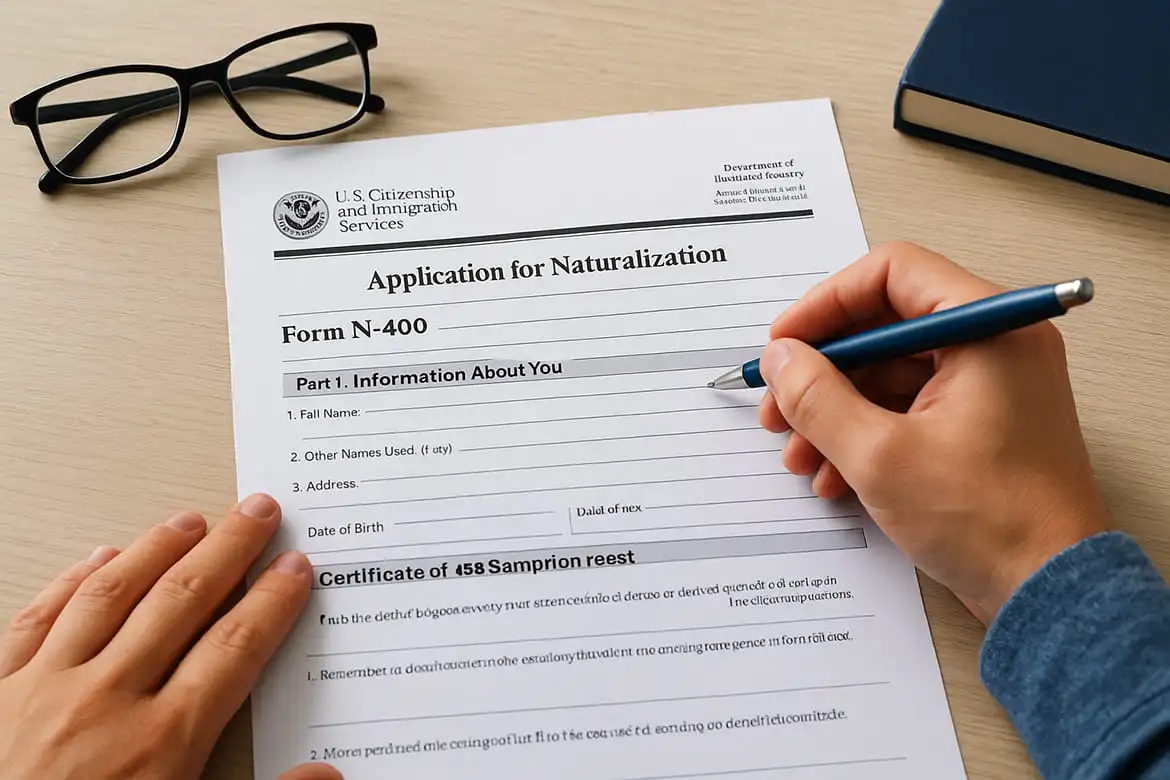
I'm scared of making a mistake on the form. What if I accidentally get something wrong and USCIS thinks I'm lying?
This is one of the most common fears I hear, and it's a valid one. USCIS officers are trained to distinguish between honest errors and deliberate misrepresentation — but they can only do that if your application is consistent. If your travel dates say three trips but your passport shows five, that looks intentional even if it wasn't. That's exactly why thorough document preparation matters: I cross-check every entry you provide against your supporting documents to make sure the information on the form is consistent and complete before it goes to USCIS.
Here's what you need to gather before filing:
- Green card (front and back copy)
- Complete travel history for the past 5 years (every trip, with exact dates)
- Marriage certificate if applying under the 3-year rule
- Divorce decrees or death certificates for any prior marriages
- Court records for any arrests, citations, or charges — even if dismissed
- Selective Service registration confirmation (for applicable male applicants)
- Child support documentation if applicable
- Tax records may be required depending on your circumstances and basis for naturalization — particularly for marriage-based cases under INA §319(a) or if there are tax compliance concerns
Note: As of December 2025, passport-style photos are no longer submitted with the N-400 application. USCIS now captures photos digitally at your biometrics appointment.
I prepare every N-400 with complete, organized supporting documents so nothing is missing when USCIS opens the file. When I say "complete," I mean the kind of complete where the officer doesn't need to send a single Request for Evidence — because each RFE adds 60 to 90 days to your case while you respond and USCIS reviews it again. In a system processing 11.3 million pending cases, an RFE doesn't just add paperwork — it sends your file to the back of the line. Read my detailed N-400 form instructions guide for a section-by-section walkthrough.
✓ What's included with my $750 N-400 document preparation
Complete Form N-400 preparation using information you provide, document organization and review, two extra document sets, translation of foreign-language documents, document pickup and delivery, same-day messenger service, copying/printing/scanning/shipping, and lifetime free follow-up appointments (a $75/each value). I also help applicants prepare for the civics test and interview. No hourly billing, no surprise charges.
Step 2: File your application and complete biometrics
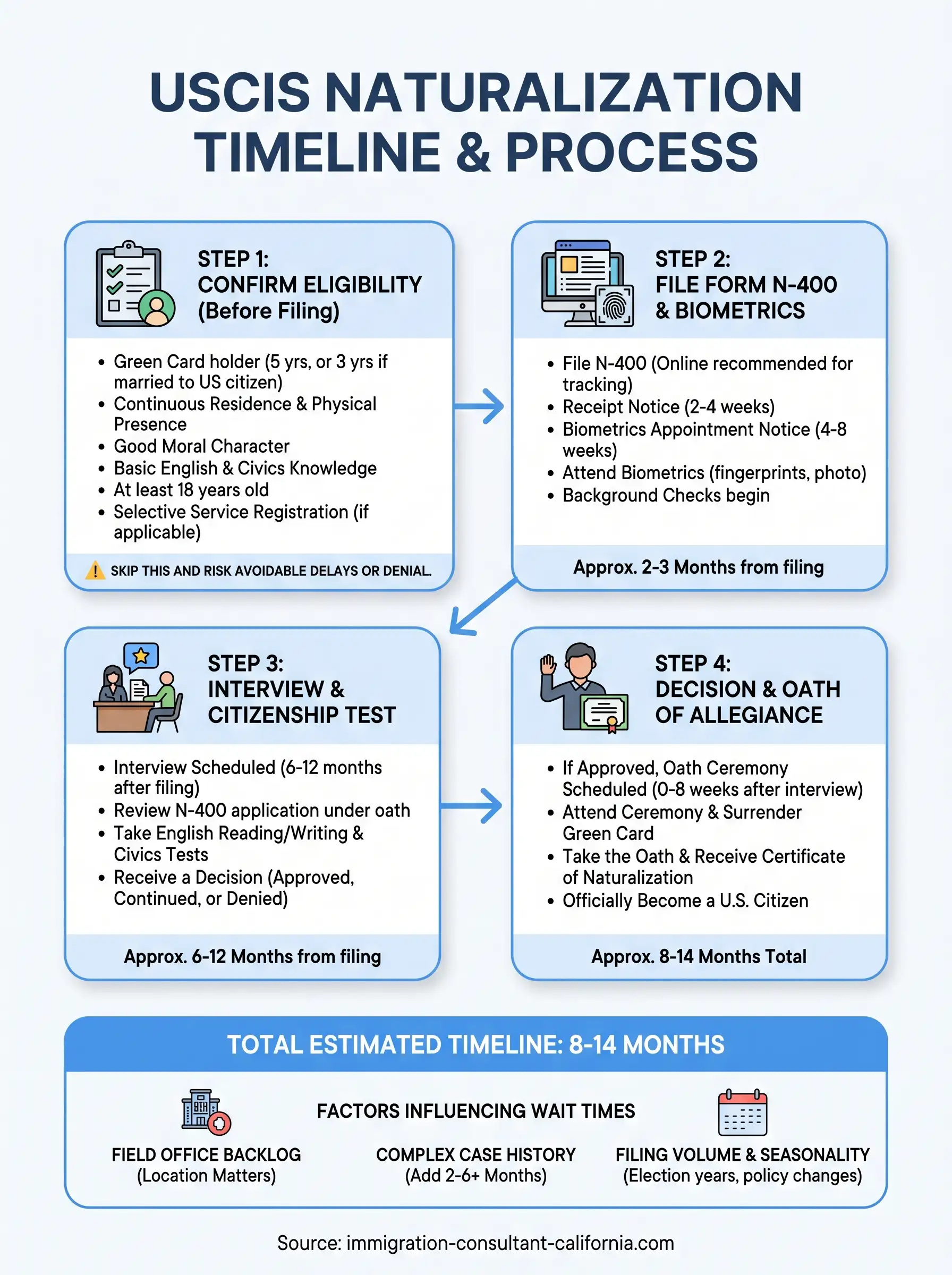
Once your N-400 is complete, you file it with USCIS either online or by mail. Online filing through your USCIS account tends to move slightly faster because it eliminates manual data entry and gives you real-time case status updates. The current USCIS filing fee is $710 when filing online or $760 by mail, which includes the biometrics fee. A reduced fee of $380 is available for applicants with household income at or below 400% of the federal poverty guidelines (paper filing only). Full fee waivers (Form I-912) are available if your household income falls below 150% of the federal poverty guidelines. Note: A proposed rule published June 2026 would significantly increase N-400 fees — file sooner rather than later if you're considering it.
After USCIS receives your application:
- Receipt notice (Form I-797C): arrives within 2 to 4 weeks confirming your case was accepted
- Biometrics appointment notice: typically 4 to 8 weeks after filing
- Biometrics appointment: fingerprinting, photo, and signature at your local Application Support Center — takes about 30 minutes
- Background and security checks: run in parallel after biometrics, usually completing before your interview gets scheduled
Missing a biometrics appointment without rescheduling in advance can stall your case for months. Treat that notice as a fixed commitment.
USCIS has reduced how often it requires in-person biometrics for N-400 cases, sometimes reusing fingerprints already on file from your green card application. But plan for the appointment unless your notice explicitly says it's been waived.
I've heard about people getting arrested at USCIS offices. Should I be concerned?
This fear is real and grounded in real data. In 2026, ICE has arrested people at USCIS offices — 539 arrests in the San Francisco area alone, with 69% having no criminal record. Whether attending a USCIS interview carries personal risk is a legal question that depends on your individual circumstances — it is not something I can assess as an immigration consultant. If you have any concerns about prior immigration violations, outstanding removal orders, arrests, or other legal issues, consult a licensed immigration attorney or DOJ-accredited representative before filing or attending an interview. I can refer you to one directly.
Step 3: Attend your naturalization interview and take the civics test
Once background checks clear, USCIS schedules your citizenship interview. In California, this typically happens 6 to 12 months after filing, depending on your field office's backlog. The interview notice arrives by mail with a specific date, time, and location — usually giving you several weeks to prepare.

During the interview, a USCIS officer:
- Reviews your N-400 application line by line, verifying every answer against your documents
- Asks about your background, travel history, employment, and moral character
- Tests your English reading ability (read 1 sentence correctly out of 3)
- Tests your English writing ability (write 1 sentence correctly out of 3)
- Administers the civics test (details in the next section)
What should I bring to the citizenship interview?
Your green card, state-issued photo ID (driver's license or state ID), your interview notice (Form I-797C), and any documents listed on the notice. Also bring your passport and any travel documents. If you've had name changes, arrests, or tax issues since filing, bring documentation for those too. A missing document can force a reschedule that adds months to your case.
Inconsistent answers are a red flag. If you told USCIS you took three trips abroad but your passport shows five, or your employment dates don't match your tax returns, the officer may continue your case for additional evidence rather than approving on the spot. I review the entire application with each client before the interview so nothing catches them off guard.
The 2025 Naturalization Civics Test: what changed
The naturalization civics test changed significantly and you need to know exactly what you're walking into. The official name is the 2025 Naturalization Civics Test, and it applies to anyone who filed their N-400 on or after October 20, 2025. If you filed before that date, you take the previous 2008 version instead. The question pool expanded from 100 to 128 civics questions, covering new topics including recent constitutional amendments, federal agencies, voting rights, and state government structures. Here's what the test looks like now:
| Test component | Previous version | 2025 Naturalization Civics Test |
|---|---|---|
| Total question pool | 100 questions | 128 questions |
| Questions asked at interview | 10 | Up to 20 |
| Correct answers to pass | 6 out of 10 (60%) | 12 out of 20 (60%) |
| New topic areas | — | Federal agencies, voting rights, state government, recent amendments |
| Format | Oral | Oral (unchanged) |
The passing rate is still about 97%, so the test is absolutely passable with preparation. But the larger question pool and double the number of questions mean you need to study more thoroughly than applicants did under the old version. I walk every client through the question bank and help them identify the topics they need to focus on.
Exemptions exist for older, long-term residents. If you're 50+ and have held your green card for 20+ years, or 55+ with 15+ years, you can take the civics test in your native language through an interpreter. Applicants with qualifying medical disabilities may request a waiver using Form N-648. Check USCIS civics test exceptions and accommodations for details.
What if I fail the civics test?
You get a second chance. USCIS schedules a retest typically 60 to 90 days later, and you only retake the civics portion — not the English test or the full interview. If you fail the retest, USCIS denies the N-400 and you would need to file a new application and pay the fee again. With the new 128-question pool, preparation matters more than ever.
Step 4: Receive your decision and take the Oath of Allegiance
Most applicants walk out of their interview with one of three outcomes:
| Interview outcome | What happens next | Typical added time |
|---|---|---|
| Approved | Scheduled for oath ceremony | Same day to 8 weeks |
| Continued (Request for Evidence) | Submit additional documents, possible second interview | 60–90 days |
| Denied | File Form N-336 to request a hearing within 30 days | Several months |
Approval is the most common outcome when your paperwork is clean and your interview goes smoothly. Some California field offices offer same-day oath ceremonies immediately after your interview — you walk in as a green card holder and walk out as a U.S. citizen the same afternoon. Other offices schedule the ceremony within a few weeks. You'll surrender your green card, take the oath, and receive your Certificate of Naturalization that same day.
Approval isn't the finish line. Only the Oath of Allegiance makes your citizenship official, and only the Certificate of Naturalization proves it.
Once you have your certificate, you can apply for a U.S. passport, register to vote, update your Social Security records, and sponsor immediate relatives without the waiting periods that green card holders face.
How long does naturalization take in California? 2026 processing times
Processing times vary significantly by field office, and California has some of the busiest offices in the country. Here's what the data shows right now:
| California field office | Estimated N-400 processing time | Notes |
|---|---|---|
| Los Angeles | 7.5 months | Highest volume in the state |
| Santa Ana (Orange County) | 8–12 months | Where my clients file most often |
| San Diego | 8–11 months | Moderate volume |
| San Francisco | 9–14 months | Higher backlogs historically |
| Sacramento | 8–12 months | Central Valley cases routed here |
| Fresno | 7–10 months | Lower volume, often faster |
| National average | 7.9 months | 80% of cases complete in 8–17.5 months |
You can check the latest processing time for your specific field office at egov.uscis.gov/processing-times. I check this tool before every client consultation so I can give realistic expectations, not generic estimates.
Why does the same application take 7 months in one city and 14 in another?
Each USCIS field office has its own staffing levels, interview scheduling capacity, and case backlog. Two applicants with identical paperwork can wait very different lengths of time simply because they live in different counties. The Los Angeles office processes enormous volume but has more officers, while smaller offices may have fewer staff and longer per-case wait times. Filing during a quieter period — avoiding election years and policy-announcement surges — can also shave real time off your wait.
The USCIS backlog: what you're up against
The processing numbers above exist in the context of a system under serious pressure. USCIS had over 11.3 million pending cases at the start of 2026 — up 16.5% from the prior year. The average case clearance time across all types is 18.6 months. Denial rates are climbing: EB-1A extraordinary ability petitions went from 25% to 52.5% denials. DACA renewal processing has stretched from 15 days to over 120 days. The agency is processing more cases than ever but falling further behind.
What does this mean for your citizenship application? It means a clean, complete filing matters more than ever. When the system is this backlogged, every Request for Evidence pushes your case behind thousands of other applications waiting for officer attention. An RFE doesn't just add 60–90 days of paperwork — it resets your position in the queue. My job is to make sure your N-400 documents are complete, consistent, and organized so nothing triggers an avoidable RFE.
What causes delays (and what you can control)
| Delay factor | Typical impact | Can you control it? |
|---|---|---|
| Field office backlog | Weeks to several months | No — but you can check times before filing |
| Incomplete or inconsistent application | 60–90 days per RFE | Yes — file it right the first time |
| Complex case history (criminal, travel, tax) | 2–6+ months added | Partially — disclose everything upfront |
| Filing during high-volume periods | 1–3 months added | Yes — time your filing strategically |
| Missing biometrics appointment | Months of rescheduling | Yes — show up on time |
| Name/address change during processing | Weeks to months | Yes — notify USCIS immediately |
| Background check holds (FBI/CIA) | Unpredictable | No |
How much does citizenship cost? Full fee breakdown
Cost anxiety is one of the top reasons people delay filing. I hear it constantly: "Is it worth paying someone, or should I just do it myself?" and "How do I know I'm not getting overcharged?" These are fair questions, especially when people in online communities describe spending thousands on attorneys who never returned their calls, or paying consultants who submitted the wrong forms. Here's exactly what citizenship costs in 2026:
| Cost | Amount | Notes |
|---|---|---|
| USCIS filing fee — online | $710 | Includes biometrics fee |
| USCIS filing fee — paper | $760 | Includes biometrics fee |
| USCIS reduced fee (qualifying applicants, paper only) | $380 | Income at or below 400% FPL |
| USCIS fee waiver (Form I-912, paper only) | $0 | Income below 150% FPL |
| My document preparation fee | $750 | Includes everything listed above — no additional charges |
| Total (online filing) | $1,460 | Complete cost for most applicants filing online |
For comparison: immigration attorneys in California typically charge $1,000 to $2,500 for N-400 preparation alone, plus the USCIS filing fee. That puts the total attorney cost between $1,710 and $3,210. And here's a number that matters: only 2% of California attorneys practice immigration law, which means the ones who do are in high demand and charge accordingly. Meanwhile, 25 California counties have zero accredited representative organizations — leaving entire regions without affordable immigration help. My fee covers the same document preparation work at a fraction of the cost because I'm a registered immigration consultant, not an attorney. The forms I prepare are identical to what an attorney would file — USCIS processes them the same way regardless of who prepared them.
I also provide free services for qualifying low-income families, with turnaround times of 30 to 90 days. If cost is the reason you haven't filed, call me — there may be options.
What's the difference between an immigration consultant and an immigration attorney?
An attorney can give legal advice, determine your legal eligibility for immigration benefits, and represent you before USCIS or in immigration court. I cannot do any of those things — and I won't pretend otherwise. What I can do, and what I'm registered and bonded by the State of California to do under BPC §22440–22448, is complete your immigration forms using information you provide, translate your answers, organize your supporting documents, and submit your application. For straightforward N-400 cases, the document preparation is the actual work. If your case involves eligibility questions, deportation proceedings, criminal history, or appeals, I'll refer you to an attorney. I don't take cases I can't handle, and I'll tell you directly if yours needs a lawyer.
How to avoid immigration consultant scams in California
I bring this up because the scam problem in this industry is real, and if you're reading this page, you've probably already worried about it. In March 2026 alone, three immigration consultant firms were sued in Sacramento — one charged a client $5,000 to "release" a green card the client already had. The LA County District Attorney prosecuted a fake consultant on 38 felony counts after bilking 32 victims. And the Alexandra Lozano scandal exposed over 53,000 pending cases built on fabricated claims, with clients charged $10,000 to $15,000 each for work that was fraudulent from the start.
Here's how to protect yourself:
- Verify the bond. California law requires every immigration consultant to carry a $100,000 surety bond filed with the Secretary of State. If someone can't show you a verifiable bond number, walk away. My bond — #73808846, Western Surety Company — is verifiable online right now.
- Demand a written contract. California BPC §22442 requires a written contract in the client's language before any work begins. No contract = illegal operation.
- Never pay someone who promises a specific outcome. No consultant and no attorney can guarantee approval. Anyone who does is lying.
- Check for complaints. Search the consultant's name with the Secretary of State, BBB, and your county DA's office.
- Ask for the bond number, not just a claim of being bonded. A real bond number is verifiable in seconds. My clients verify mine before signing anything, and I encourage it.
✓ My verifiable credentials
Bond #73808846 – Western Surety Company – $100,000 surety bond filed with the California Secretary of State. Verify online →
Registered under California Business & Professions Code §22440–22448.
Continuously bonded for 6+ years (since at least August 2020).
Office: 3001 Red Hill Ave, Building 6, Suite 210, Costa Mesa, CA 92626.
Why applicants across California choose to work with me
The most common complaint I hear from people who've been burned by other consultants or attorneys isn't about competence — it's about communication. "They took my money and stopped answering the phone." "I called for weeks and nobody called me back." "They had an assistant fill out my form and got my travel dates wrong." These stories come up in nearly every first consultation. Here's how I work differently:
- I answer the phone 7 days a week. Not an assistant, not a voicemail tree. Me. The most common complaint in immigration consultant reviews across California is non-responsiveness after payment. That's not how I operate — my clients can reach me when they need to.
- I speak English, Urdu, Pashto, and Hindi. If you're more comfortable discussing your case in your language, that's what I'll use. Details matter in immigration paperwork, and language barriers cause mistakes that trigger RFEs.
- I pick up and deliver documents. If getting to my Costa Mesa office is a challenge — you work long hours, you don't have transportation, your schedule doesn't allow it — I come to you. Your application doesn't wait because you couldn't get time off.
- I prepare every form myself. No assistants filling in your N-400, no assembly-line processing. I review your case, prepare the documents, and stand behind the work. When a client calls me at 8 PM asking about their case, I know the answer because I built the file.
- Lifetime free appointments after your case. Need help with your passport application, voter registration, or a future petition for a family member? My door is open at no charge. You're not just a case number that closes when USCIS approves you.

Common mistakes that delay or sink citizenship applications
After six years of preparing N-400s, I see the same preventable errors over and over. These aren't edge cases — they're the mistakes that real applicants post about on Reddit and Quora after their cases get stuck:
- Employment history inconsistencies. 40% of applicants face delays because their stated employment history doesn't match supporting records. Dates and employer names need to be exact.
- Travel dates that don't match passport stamps. USCIS officers cross-reference your stated travel history against your passport. If you said three trips but stamps show five, your credibility takes a hit — and credibility matters more than ever in the current enforcement climate.
- Blank fields instead of "N/A." A blank field looks like an incomplete form. Write "N/A" or "None" for every question that doesn't apply to you.
- Not disclosing arrests — even dismissed ones. USCIS asks about all encounters with law enforcement, not just convictions. Failure to disclose can be treated as a lack of good moral character, which is worse than the original issue. People assume dismissed charges "don't count." They do.
- Filing under the wrong rule. Applying under the 3-year spouse rule when the marriage ends before the Oath of Allegiance — not just the interview — can result in denial and a wasted filing fee. This is a legal question best addressed by an attorney.
- Not checking Selective Service registration. Men who lived in the U.S. between 18 and 26 must have registered. If you didn't, you may need a Status Information Letter from the Selective Service System and a written explanation showing the failure to register was not knowing and willful.
- Extended trips abroad without understanding the consequences. A trip of more than 6 months can create a presumption that continuous residence was broken. A trip over 1 year generally does break it. Understand your travel history before filing.
Physical presence and continuous residence: the rules that trip people up
The physical presence requirement is where I catch the most eligibility problems. You need to have been physically in the United States for at least half of the required residency period — 30 months out of 5 years, or 18 months out of 3 years. And you need to count actual days, not estimate.
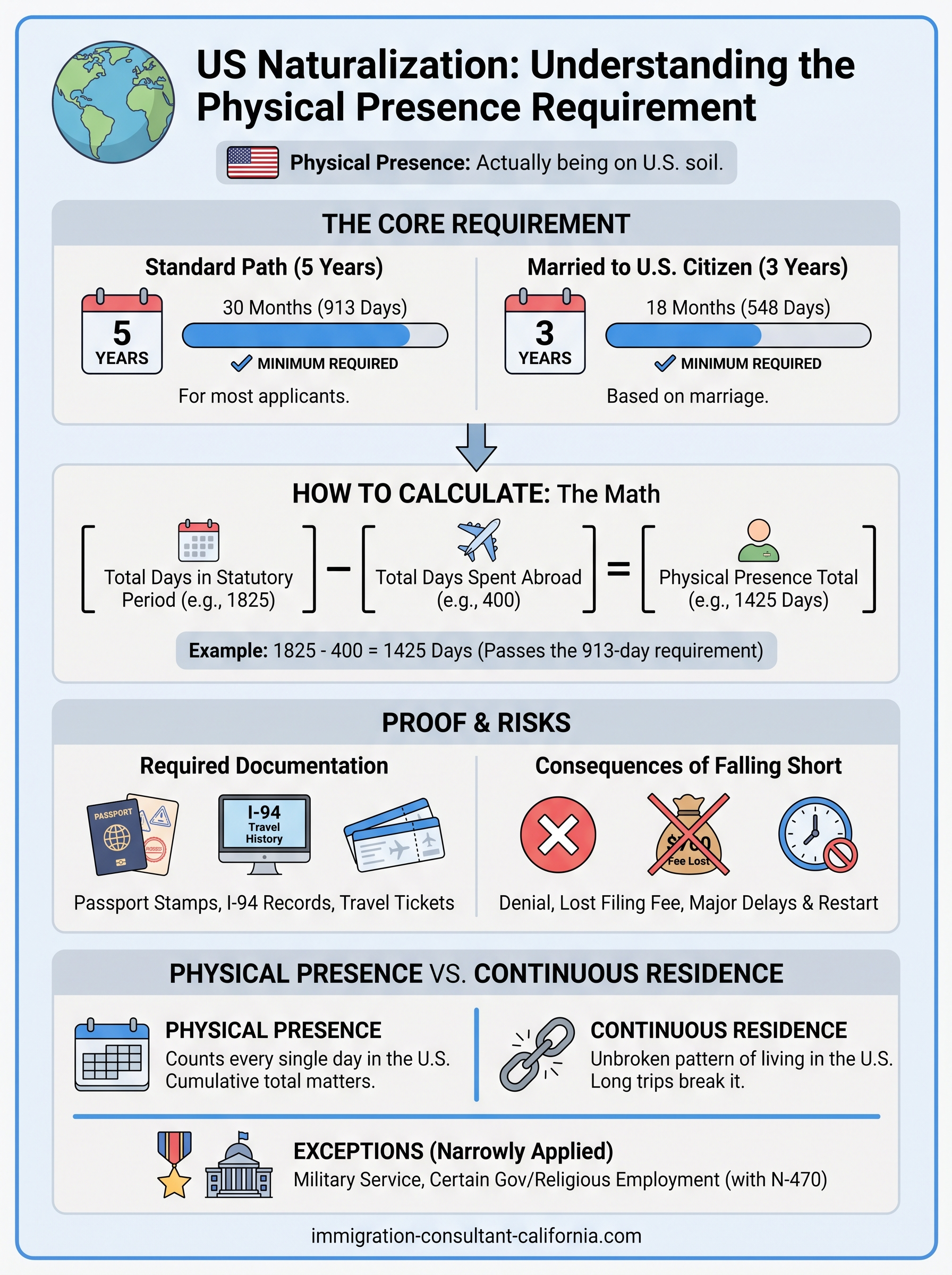
Continuous residence is a separate requirement. A single trip outside the U.S. lasting more than 6 months but less than 1 year creates a rebuttable presumption that continuous residence was disrupted. This is not an automatic bar — USCIS allows applicants to submit evidence showing they maintained their residence, such as proof they kept a U.S. home, did not take employment abroad, and their immediate family remained in the U.S. A trip of 1 year or more generally does break continuous residence, though applicants who filed Form N-470 before the 1-year mark to preserve their residence for qualifying employment abroad may be excepted. I've had clients walk in assuming extended travel wouldn't matter, only to discover it created a presumption they needed to address. I help organize travel documentation using passport stamps and supporting records, because getting this wrong can mean significant delays.
California field office processing: what to realistically expect
California is home to some of the busiest and some of the fastest USCIS field offices in the country. Where you file is determined by your zip code, not by your choice, so understanding your local office's performance helps you plan realistically. Here's the general timeline for a clean N-400 filed in California in 2026:
| Stage | Typical California timeframe |
|---|---|
| File N-400 → Receipt notice | 2–4 weeks |
| Receipt → Biometrics appointment | 4–8 weeks |
| Biometrics → Interview scheduled | 4–9 months (varies by office) |
| Interview → Oath ceremony | Same day to 8 weeks |
| Total: filing to citizenship | 7.5–14 months |
These are realistic ranges based on current USCIS data and my experience with cases across California. Your individual timeline can be shorter or longer depending on background check results, RFEs, and your field office's current workload.
Frequently asked questions about citizenship and naturalization
Can I apply for citizenship if I have a criminal record?
Possibly — it depends entirely on the nature and timing of the offense. Minor traffic violations generally don't affect naturalization. Misdemeanors may or may not affect good moral character depending on what they were and when they occurred. Felonies and aggravated felonies are serious bars to naturalization. If you have any criminal history, disclose everything on your N-400 and bring court records to your interview. For complex criminal situations, I'll refer you to an immigration attorney — that's the honest answer, not a dodge.
What happens to my green card when I become a citizen?
You surrender it at the oath ceremony. You won't need it anymore — your Certificate of Naturalization and eventually your U.S. passport replace it as proof of your status. Keep copies of your green card before the ceremony for your personal records.
Can my children automatically become citizens when I naturalize?
Generally, children under 18 who are lawful permanent residents and reside in the legal and physical custody of a U.S. citizen parent may automatically acquire citizenship under the Child Citizenship Act. They don't need to file their own N-400. To document their citizenship status, they can apply for a Certificate of Citizenship (Form N-600) or obtain a U.S. passport — either serves as evidence of citizenship, and neither is legally required. Whether a specific child qualifies involves legal analysis, so consult an immigration attorney if your situation is complex.
I've been a green card holder for 20 years and never applied. Is it too late?
It's not too late, but in the current climate, waiting carries real risk. A green card can be revoked or abandoned under certain circumstances, while naturalized citizenship can only be revoked in limited circumstances under federal law — such as where it was obtained through fraud or concealment of material facts. The longer you hold a green card without naturalizing, the more you're exposed to changes in enforcement policy, processing backlogs, and evolving requirements. If you've been putting it off for years, now is the time to seriously consider filing. AAPI arrests in California are up 1,109% year-over-year. Naturalization provides substantially greater security than permanent resident status.
What if I need to travel while my N-400 is pending?
You can travel, but be strategic about it. Short trips (under 6 months) generally don't cause problems, but keep all boarding passes and passport stamps. A trip longer than 6 months may create a presumption that continuous residence was broken, which could affect your case. If you're considering extended travel while your case is pending, consult an immigration attorney about how it might affect your application.
Do I need to speak perfect English to pass?
No. USCIS tests basic English — you need to read one simple sentence correctly out of three attempts, and write one simple sentence correctly out of three attempts. The level is roughly elementary school English. Applicants who are 50+ with 20+ years of permanent residence, or 55+ with 15+ years, can take the civics test in their native language.
Should I use a consultant or a lawyer for my N-400?
For straightforward document preparation — no criminal history, no complicated travel or tax issues, no eligibility questions — a consultant handles the same form completion work at a lower cost. The forms are identical regardless of who prepares them. Only 2% of California attorneys practice immigration law, which drives prices up and availability down. If your case has complications that need legal analysis — eligibility questions, deportation risk, criminal history, fraud concerns — you need an attorney. I don't make that determination for you, but I'll tell you directly if your situation sounds like one where legal advice would be appropriate, and I'll refer you.
Start your citizenship application today
Every month you wait to file is a month you're not in the USCIS queue. Processing times aren't getting shorter — the backlog hit 11.3 million cases this year — and the enforcement environment is making the stakes of staying on a green card higher every month. Immigrants across California are dropping out of Medi-Cal, skipping medical appointments, and pulling their kids from school programs out of fear. Naturalization provides substantially greater protection against these risks.
I offer free phone consultations 7 days a week at 714-229-1322. I can walk you through the general requirements, explain what documents you'll need, and give you a realistic timeline based on your field office's current processing times. If you're ready to move forward, I'll prepare your complete N-400 package for a flat $750 — no hourly billing, no surprise fees, no unanswered phone calls. If your situation involves legal questions about eligibility, I'll refer you to a licensed immigration attorney.
You've already done the hardest part: building a life in the United States as a permanent resident. Naturalization provides substantially greater security than permanent resident status, gives you the right to vote, and significantly reduces your exposure to the enforcement climate affecting millions of green card holders right now. I've helped families across California through the document preparation process for over six years, and I'd be glad to help yours.
See also: Difference Between Green Card and Citizenship · Green Card for Parents of U.S. Citizens · Fee Disclosure · Why Choose a Bonded Immigration Consultant
About

I am dedicated to providing professional service with the highest degree of honesty and integrity, and strive to add value to every immigration case I handle.
Afridi Immigration Document Preparation Services
I am Not an Attorney and Cannot Give Legal Advice
Bond Information:
As required under California law, I am bonded in the amount of $100,000.
Bond Number: 73808846 – SHAFI AFRIDI
Bonding Company: Western Surety Company
101 S. Reid St., Ste 300 , Sioux Falls, SD 57103-7046
Bond Filed With: California Secretary of State